
What Are the Warehouse Forklift Types?
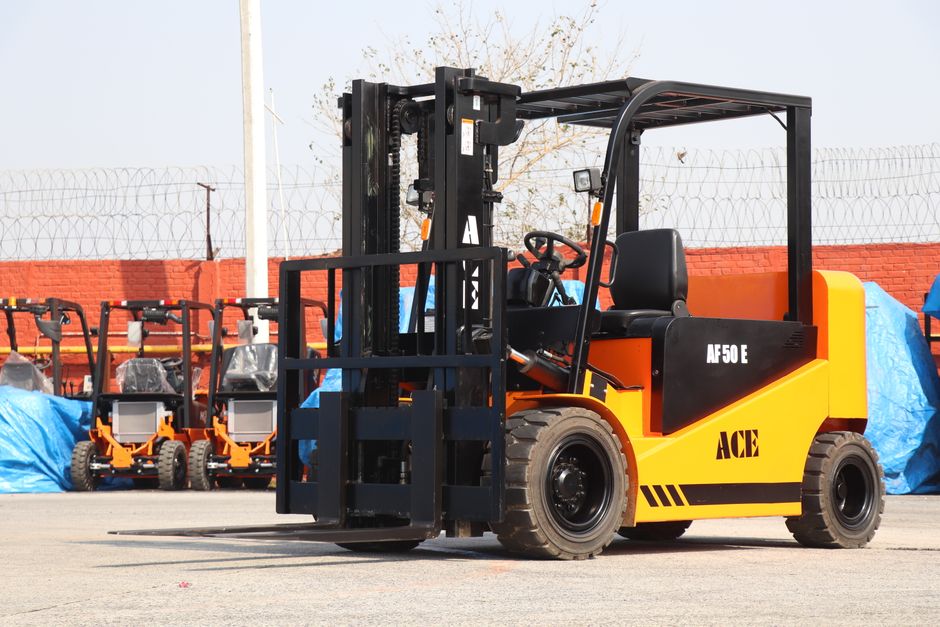
The seven warehouse forklift types are counterbalance trucks, reach trucks, order pickers, pallet trucks, stackers, very-narrow-aisle (VNA) or turret trucks, and side loaders. Choose among them by matching the truck to aisle width, rack height, load shape and weight, floor conditions, and whether the task is moving pallets or picking goods. Check the truck’s data plate and model-specific aisle specification before use.
What are the 7 types of forklifts?
The seven types are counterbalance trucks, reach trucks, order pickers, pallet trucks, stackers, VNA or turret trucks, and side loaders. Each suits a different mix of travel, lifting, picking, and load shape.
- Counterbalance truck: A rear counterweight balances the load carried at the front. The UK Material Handling Association (UKMHA) describes these trucks as flexible, with popular capacities of 1,000–3,000 kg and lift heights of 3–6 m or more depending on mast configuration.
- Reach truck: The load sits partly within the chassis. UKMHA describes reach trucks as common in warehouses and narrow-aisle racking, designed for indoor use on smooth floors with solid tires.
- Order picker: This truck is built for picking goods at shelf level rather than handling full pallets as its main job. Crown notes that man-up trucks elevate the operator in very narrow aisles for order picking and stock replenishment.
- Pallet truck: Used to move pallets where vertical stacking is not required. UKMHA describes electric pallet trucks as moving and picking equipment, with capacities up to about 3,500 kg depending on model.
- Stacker: A warehouse truck for moving and stacking loads. Crown says walkie stackers serve loads stored up to 16 ft high and generally suit minimal travel distances.
- VNA or turret truck: Built for very narrow aisles and high storage. UKMHA cites configurations handling 1,500 kg at up to 17 m, depending on specification; rail, wire, or radio guidance can help positioning.
- Side loader: Carries long or protruding loads, such as timber, steel rods, and pipes, which do not fit neatly across ordinary forks.
These names describe truck designs and tasks. OSHA’s classifications describe powered industrial truck classes, a separate system.
What type of forklifts are used in a warehouse?
Warehouses use the forklift type that fits their workflow, load, aisle, rack, and floor. A pallet truck moves goods without vertical stacking; a stacker adds storage at moderate heights; reach trucks and counterbalance trucks serve pallet handling in different aisle and floor settings; order pickers support shelf-level picking; VNA trucks serve very narrow, high aisles; side loaders carry long loads.
Use this decision table to narrow the choice. These are task matches, not substitutes for checking the exact model specification.
| Condition or workflow | Types to assess | Selection check |
|---|---|---|
| Indoor, smooth floor; narrow racking aisles | Reach truck; VNA/turret for very narrow aisles | Measure the aisle and confirm the model’s aisle figure. VNA needs precise positioning and suitable floor conditions. |
| Indoor, no vertical stacking | Pallet truck | Match capacity to the load and travel pattern. |
| Indoor, stacking with limited travel | Stacker | Check maximum lift height and capacity for the stored load. |
| Front-loaded pallet work or flexible handling | Counterbalance truck | Check the floor, load dimensions, capacity, and turning space. |
| Picking individual goods at shelf level | Order picker | Match operator elevation and picking workflow to the rack layout. |
| Long or protruding loads | Side loader | Assess the load shape and the space needed to travel and turn. |
| Outdoor or uneven terrain | Assess a suitable truck and tire configuration, including rough-terrain models where appropriate | Do not assume a class name guarantees suitability for every surface. |
The available sources do not set one aisle width for each truck type. Toyota Material Handling Europe defines the right-angle stacking aisle (Ast) as the minimum straight-aisle width for a truck carrying a specified load to turn 90 degrees. Its calculation depends on the truck’s turning radius and the load’s dimensions and position. Toyota uses 200 mm clearance in its formulas, but models and brands differ, so the model-specific data sheet matters more than a generic range.
For VNA trucks, aisle width is only one part of the fit. UKMHA says rail, wire, or radio guidance can assist positioning and that floor condition is critical. Rack compatibility and a planned guidance system belong in the same decision as the truck itself.
What are the three main types of forklifts?
There is no single three-type grouping that replaces the seven designs. A practical task-based grouping is pallet-moving trucks, pallet-stacking trucks, and picking or specialized-load trucks.
Pallet trucks move loads without vertical stacking. Counterbalance trucks, reach trucks, and stackers lift and place loads, but differ in chassis design, aisle use, and operating conditions. Order pickers, VNA trucks, and side loaders address specific workflows: shelf picking, dense high-bay storage, and long loads.
This grouping helps sort the decision, but it does not dictate the purchase. OSHA lists seven powered industrial truck classes, and those classes do not map one-to-one onto common warehouse names.
What is a Type 4 forklift?
A Type 4 forklift is OSHA Class IV: an internal-combustion engine truck with solid or cushion tires. OSHA’s wording is “Class IV: Internal Combustion Engine Trucks (Solid/Cushion Tires).”
Class IV is a regulatory class, not a general name for one warehouse design. OSHA’s seven common powered industrial truck classes are Class I electric rider; Class II electric narrow-aisle; Class III electric hand or hand-rider; Class IV internal-combustion solid/cushion tire; Class V internal-combustion pneumatic tire; Class VI electric or internal-combustion tractors; and Class VII rough-terrain trucks. OSHA says these are examples and do not include every powered industrial truck covered by the standard. It also cautions that “rough terrain” does not mean every Class VII truck is safe on every terrain.
How should you check aisle width, lift height, and capacity?
Use the actual truck, load, and rack layout. A broad category name cannot confirm that a specific configuration will fit or lift safely.
- Read the data plate. OSHA says it identifies capacity, truck weight, fuel type, and other specifications. Do not operate a truck with a missing or illegible plate.
- Match the load to the rating. Capacity assumes the load center and weight distribution stated on the plate. Measure the pallet and load; irregular dimensions can change the effective load center.
- Account for attachments. OSHA’s example plate rates a truck at 5,000 lb at a 24-inch load center with forks, but 4,500 lb with a sideshifter. The same example lists maximum lift heights of 130 inches and 156 inches for those configurations. An attachment can change both capacity and working limits.
- Check the required rack height. Compare the intended lift height and load capacity with the plate for the truck’s actual configuration.
- Measure the aisle and use the model’s Ast figure. Toyota recommends checking actual rack-to-rack space, pallet overhang, rack protection, pedestrian paths, and the data-sheet aisle figure. The right-angle turn depends on both truck geometry and load dimensions.
For a photo-based identification check, look at what the truck carries and where the operator stands: front forks balanced by a rear counterweight indicate a counterbalance design; a load drawn partly into the chassis suggests a reach truck; an elevated operator platform points to an order picker or man-up VNA truck; a low fork unit signals a pallet truck; a compact walkie unit with a mast suggests a stacker; a turret arrangement points to VNA pallet handling; and side-mounted forks suit long loads. Confirm the model and data plate before treating appearance as a specification.
Frequently Asked Questions
What is the difference between a reach truck and a counterbalance forklift?
A counterbalance truck uses a rear counterweight to balance a load carried at the front. A reach truck carries the load partly within its chassis and is designed for indoor use on smooth floors, often in narrower warehouse aisles.
Which forklift type works best in narrow warehouse aisles?
Reach trucks are commonly used in narrow-aisle warehouses. For very narrow aisles and high racks, a VNA or turret truck can fit the task, but it requires careful aisle and rack planning; guidance systems and good floor conditions are also important.
How do I match forklift type to rack height and load capacity?
Check the truck’s data plate for rated capacity and maximum lift height, then compare those figures with the actual load, its dimensions, and the required rack level. Confirm the model’s right-angle stacking aisle specification against measured rack-to-rack space, allowing for pallet overhang and the truck’s turning needs.
Sources
- Occupational Safety and Health Administration (OSHA), Powered Industrial Trucks: Classes
- Occupational Safety and Health Administration (OSHA), Nameplates
- Toyota Material Handling Europe, Aisle Width Guide
- UK Material Handling Association (UKMHA), Layman’s Guide
- Crown Equipment Corporation, Product and Service Guide
Related reading
What Does a Warehouse Forklift Operator Do?
A warehouse forklift operator moves and tracks materials, while pay varies by location, shift, experience, and equipment.

How Can Hotels Build Leadership Development That Retains Staff?
Build practical hotel leadership paths that prepare frontline employees for management and help supervisors support retention.

Do Dubai Freelancers Need to Register for Corporate Tax and VAT?
Understand when Dubai freelancers face corporate tax and VAT registration, how to file, and whether UAE Small Business Relief may apply.

How Do You Redesign Conference Sessions for Peer Learning?
Plan conference sessions around attendee goals with interactive formats, peer learning, and measures of usefulness beyond applause.